Monday, April 4, 2011

On the Road Again

ruins recently excavated near San Miguel de Allende

I often lament to friends and family my not traveling as much as I say I would like. Well, I haven’t booked a flight to Buenos Aires yet, but I did take some baby steps in the past few weeks by driving around Central and Western Mexico with a friend. We stopped in Lagos de Moreno, Guanajuato, San Miguel de Allende, Patzcuaro, and Morelia on the first leg, then Mascota, Talpa, and Tapalpa on the second.

“Isn’t that dangerous?” more than one person asked when they heard of my plan. Holdups and random acts of violence permeate the news from Mexico.

My experience, however, was as pleasant as it has always been here: friendly locals who smiled at us as we walked around their town snapping photos; well-mannered kids stepping off narrow sidewalks to give space to us elders; new arrivals at restaurants saying “Buen provecho” as they passed our table.

But the bad press must have left its mark somewhere in my subconscious because I felt apprehensive when I pulled off a back road in Michoacan to look at my map and a big-wheeled pickup with two men in it stopped behind me. One of them got out and approached my open window.

"Are you all right?” he asked in accent-free English. “Can I help you?” He then gave me what turned out to be perfect directions to the little town I was looking for, returned to his truck, and, along with his passenger, gave me a cheery wave as they went on their way.

Capula, the pueblo I was looking for, remains one of my favorites. Famous for its “brownware,” i.e. brown clay tableware, hand painted and glazed, Capula’s finest artisans are pointillists whose intricate fish and birds vibrate with color. Fabulous prices (around $20 USD for a plate beautiful enough to hang on a wall + matching salsa bowl) meant I could load up on gifts for friends as well as refresh my own stock at home in San Pancho.

It was fun to walk around Tzintzuntzan again, too. Pronounced “tseen-TSOON-tsan” it means Place of the Hummingbirds and is a pre-Hispanic town that specializes in straw goods. My husband Marsh bought a straw hat there years ago and always wore it to the Vallarta airport when picking up houseguests.

“I was angling for a comment on my hat,” he used to confess when someone commented on it, ”just so I could tell you where it comes from and say “tseen-TSOON-tsan.”

I always succumb to the charms of colonial beauties Guanajuato and San Miguel de Allende, captured in this video: http://www.youtube.com/watch?v=6c0MIWRTHCE I thought, and still think, that I would have chosen Guanajuato as my new hometown if the pull of the ocean weren’t so strong. The University of Guanajuato is a big plus for me. Known for its arts programs, it attracts over 15,000 students and gives the city a youthful vitality and a rich cultural life that includes the fabled international Cervantino festival every October. I went one year and loved it.

Note to self: talk up the Cervantino festival among friends and go again this year. Return to Oaxaca for Day of the Dead, too. And to Mexico City to experience the renowned anthropology museum. And to Tulum to swim in the surreally turquoise water.

Get out there, as the old cruise line ad used to say.

Thursday, February 24, 2011

Valentine's Day in El Tuito


The B & B where we stayed on February 14 was perfect for a Valentine’s Day getaway. Located south of Puerto Vallarta in the quiet old town of El Tuito, El Jardin (The Garden) is run by a French couple whose taste runs to the romantic. “A Touch of Paris in Mexico” is the hotel’s motto. Draperies of raspberry-colored silk, diaphanous panels used as room dividers, fluffy pink towels, and candles, candles, candles made for a sensuous setting. Feather boas and bouquets of roses added to the lavish effect.


After settling in, we browsed around El Tuito and went for dinner at Valle Azul, a restaurant with a few sidewalk tables near the main plaza. As we waited for our coconut shrimp, we watched a vendor selling Valentine balloons and stuffed animals wrapped in pink and red. We were musing about what a special Valentine’s Day it had been, when a pickup truck loaded with a slaughtered cow pulled up and parked in front of our table. A skinless head, eyes intact and horns attached, and clear plastic bags of cow innards balanced on piles of bloody meat.

A large fellow wearing a black plastic apron hopped out of the truck, pulled up the metal door of the butcher shop next to our restaurant and backed up the truck smack against our table. I know what’s going to happen next, I thought, and I’m not going to let it bother me. Our coconut shrimp arrived.

The burly butcher slung a side of beef over his shoulder and carried it into his shop. He looked like a strong guy, but it wasn’t easy. Not going to bother me, not going to bother me, I repeated to myself. I thought of my vegetarian daughter, and though I miss her, I was glad she was not there at that moment. The butcher finished unloading the carcass just as we polished off the coconut shrimp.

We settled up with Valle Azul and I asked the butcher what he did with the horns. Unless they are especially big ones, he said, he throws them out. Seems a shame, I thought, but if there is something useful you could do with cow horns, a butcher would have thought of it by now.

In hopes of getting a photo memento of our special Valentine’s Day dinner, we stopped the next morning at the butcher shop. The sides of beef hung from hooks behind the counter, where the butcher stood, slicing fat from chunks of steak. “That was one big cow,” I observed as a conversation starter. “Very heavy, about 500 kilos--more than a thousand pounds,” he said. The butcher, whose name is Joaquin Gómez, seemed pleased when I asked if I could take a photo, and he wondered if it would be on the Internet. “I don’t have email myself,” he said, “but my sister in California does, and she can send me a copy.”

So here’s to you, El Jardin del Tuito and Joaquin Gómez. And thank you for making Valentine’s Day 2011 a memorable one.

Tuesday, February 8, 2011

The Big Chill

I was raised in the Midwest and I know cold weather. Phrases like “wind-chill, sub-zero, single digits, and deep freeze,” don’t scare hardy folks from Chicago like me. Parkas, ear-muffs, leggings, long underwear, boots, scarves, gloves and wooly socks: clothing labels that say duo-fold, fleece-lined and down-filled are winter wardrobe basics. But when the morning temperature here in San Pancho is 50 degrees, it is bone-chilling; a cold that is impossible to escape in an unheated concrete block house with clay tile floors.

There is some comfort in knowing that I am not the only person piling on the layers. Hooded sweatshirts have appeared in the pueblo. Workers huddle in the rear of pickups wearing jackets that look alarmingly like parkas. Bundled against the cold, the children are hurried along, their small feet scuffling in oversized boots. Boots?

Still, I am reluctant to mention the weather to friends and family back in the States. I am not likely to get much sympathy when they haven’t had a ray of sunshine in six weeks and the high temperature for the day is 10 degrees. And it’s true, despite the record chill, afternoons here are in the 70s and balmy; we can go to the beach.

When friends were planning a visit recently I pondered how to suggest they bring one or two warmer items to wear.

“It is a little cool in the morning,” I wrote, “and again in the evening.”

Just as I expected they reminded me of their winter endurance skills. Fine I thought, we’ll see, and put the small electric heater in their room, just in case.

It wasn’t until they had been here a few days that they conceded it was a little “cooler” than they had remembered from last year.

“Dinner on the patio?” I asked, as I carried our plates toward the door.

“Maybe eating inside would be cozier,” our guests said.

In front of the oven?

Monday, January 17, 2011

Back in Business


As I walked down San Pancho’s main street in mid-October, a sign in a shop window caught my eye: “20% OFF ON EVERYTHING UNTIL THE BRIDGE IS FIXED.” Now that sign is gone. People and vehicles can cross the river into San Pancho again, and the Avenida is bustling with commerce.

Torrential rains in early September caused flooding, mudslides and bridge collapses throughout the Bahia de Banderas area. “The most rain I can remember in 50 years,” one San Pancho old-timer said. On September 6 rushing water and fallen trees slammed into the San Pancho bridge. It collapsed, creating a crisis in both economic and human terms: The village was cut off from Highway 200 and the rest of the world; families who lived near the river banks became homeless overnight; houses were inundated with up to four feet of water.

The people of San Pancho rallied. They improvised a zipline across the river and then threw together a rickety wooden footbridge. Seventy people whose homes had been washed away lived and ate for two weeks in EntreAmigos, the town’s community center. The owners of La Patrona Polo Club donated things like baby diapers and food and sent a boatload of supplies to the San Pancho beach.

High-riding SUVs could ford the river not long after the washout, but regular cars couldn’t make it across. The water was just too high. To solve this problem a raised dirt embankment was built in late October. It is only one lane, and if you don’t have your wits about you, your car could slide into the water, but the embankment serves its purpose. Regular vehicle traffic in and out of San Pancho resumed.

Local people saw a business opportunity: all those hungry bridge workers; heavy traffic all day on the embankment. New taco stands sprang up, one of which also advertises low-cost haircuts and manicures. A portable hot dog stand parks at the site. An enterprising woman sells clothing, displayed on a clothesline like clean wash. Victoriano Mendez, the artist who used to set up his easels near the bridge, has returned, painting and selling his landscapes.

Construction is almost complete on the new bridge. San Pancho is back in business.

Wednesday, January 12, 2011

The Night Visitor


Rustling sounds from the vacant lot behind our bedroom wall stir my sleep. Is it a gentle breeze moving among the wildly overgrown thicket of plants and weeds, a brief interlude in the night? Again, the soft swishing intrudes, scuffling footsteps, an iguana or a creature beyond imagining. I am not going to wake up, I vow, but open my eyes just enough to see the clock, 2:00 a.m. It is hardly a time for an investigation; it’s dark, too dark to see anything. I snuggle further beneath the comforter, burrowing, my head tucked inside like a tortoise.

No way, now I am awake. I strain to hear the noise again; did we lock the bedroom door I wonder? But now there is only the usual cacophony of our neighborhood: dogs, roosters, faint strains of music. I drift into an uneasy sleep.

Early morning light filters through the windows. I am groggy from a fitful night and ready for coffee. I see him as soon as I open the door to the patio beyond our bedroom. He stands perfectly still, a white horse, ghostly against the striated sky. He is tethered to a long rope which corrals him into a small area just meters away from our wall. He moves slowly among the brambles, grazing steadily. I watch him for a few minutes and make tentative horse-calling noises; he doesn’t look up.

With coffee in hand, I give him the once-over. I don’t recognize this horse as one who belongs to any of my neighbors. For one thing, he doesn’t look very healthy. I can see the outline of his ribs. And what’s more, he’s quiet, not one whinny for my benefit.

I watch him throughout the day and make an occasional attempt at communication. Head down, he ignores me. His movements track the sun as it journeys to the ocean, and he stays within its warmth. In the purple/pink haze of the sunset, he glows. In the morning, he is gone.

Monday, January 3, 2011

Tlaquache Terrorism

I wrote a blog entry a couple of years ago about the possum problem in our house and garden; there are certain animal lovers who have not spoken to me since. Though the murder plot didn't come off, there was a lot of premeditation, and for possum offenses no worse than being ugly and waking us up nightly with hisses, rustlings and mating clicks. But now the situation has become worse by several orders of magnitude.
The other night I was minding my own business, heating up some leftovers for dinner on top of the stove. I had just stirred the pot and returned to the living room when the stove exploded. The Le Creuset pot flew up and over the island and landed upside down; the burner apparatus and grills likewise, the oven door blew open and wisps of insulation streamed from the joints. The neighbors came running to see if we were still alive.
Alive, yes, but considerably shaken and also dumbfounded. The oven hadn't been on; I had been cooking daily—now I vowed never to go near the stove again. It wouldn't have been pretty if I had stirred that pot a few moments later than I did. We shut off the gas, cleaned up the mess and went out to dinner. We planned to check out the stoves in the shop on the corner in the morning and when we did, we found a nice one that went better with my dishwasher anyway.
But first we really had to make an inspection. Jonathan pulled the stove out of its slot in the counter. There sat a slightly singed tlaquache in a nest of leaves showing its vicious little teeth—teeth which it had used, in its spare time, to chew through the metal mesh-clad gas line. As a parting insult, when Jonathan drove it out from under the stove, it ran and hid under the dishwasher and he had to disconnect and pull that out, too. The possum finally scurried off into the garden, where, animal lovers, it plots with impunity—for the time being.

Saturday, December 18, 2010

Yakati Yak Jack


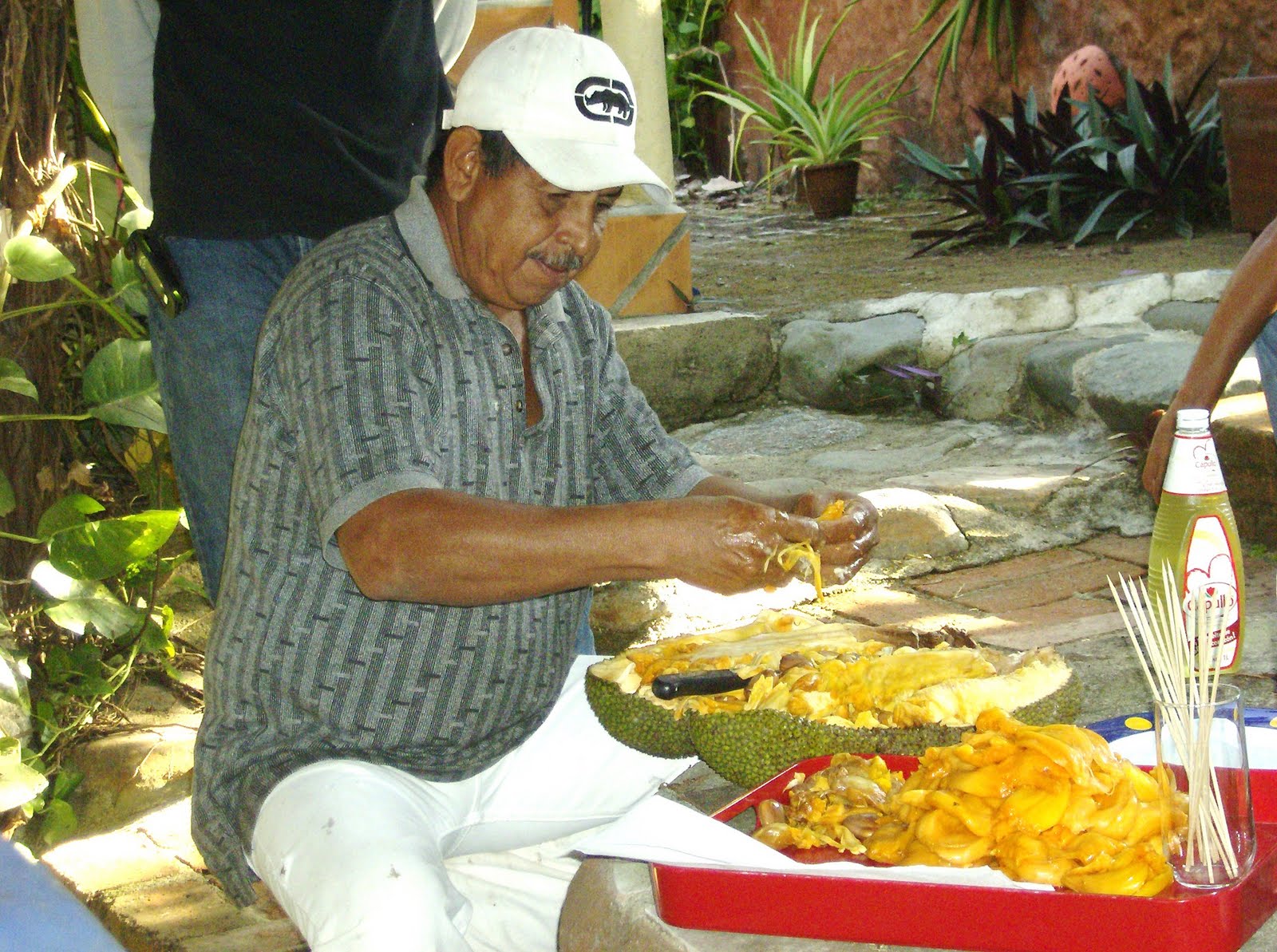
Today Manuel brings us a gift. Unannounced, he lumbers down the steps that lead from the street to our garden retreat lugging a bulbous object with both hands. His knees are splayed wide to better support the weight of what he carries. Teenage sons Harry and Edgar bring up the rear.


"Yaka," says Manuel. He looks around for an appropriate perch in which to set it down. The wide edge of the pool will do. "Deliciosa, y para la salud, excelente."


"He says it tastes good. And it’s good for you." Harry translates although we easily get the drift of where the scenario is going. Edgar wrinkles his nose. We soon learn why.


My husband and I had seen the gigantic globes of yaka, or jackfruit, hanging from hooks at fruit stands alongside the highway between Las Varas and San Pancho. We had never given close inspection. I scrutinize this specimen with suspicion as to edibility. The greenish pimply rind looks like a porcupine with snubbed-off quills. Harry tells us he doesn’t particularly like the taste of the fruit, but it’s okay when blended with milk and banana for breakfast. "Good for virility," he adds.


Okay. I’m game.


Manuel requests a knife, cooking oil, a bowl, another bowl with water, discarded newspaper. The ceremony begins. Like a surgeon he makes a clean cut, severing the beastie in two. He douses both hands in vegetable oil and plunges inside the folds of the fruit. Up to his wrists he curls his fingers around two-inch-long brown pods nestled beneath slippery squares of pale orange flesh. Pods tossed on the newspaper, pulpy flesh plopped in the bowl of water. A strong scent, like cheap perfume from the five and dime.


About 30 minutes later Manuel’s midwifery yields dozens of pods and a bowl heaped with slimy-looking foodstuff. He dunks the fruit a bit, swirls it around the bowl, offers me first bite.
Tastes like over-ripe cantaloupe this side of floozy: a little too much scent and slick for my taste, but, hey, it is interesting. Samples all around. My husband, Win, looks askance. Harry passes. So does Edgar. Manuel takes a sizeable chomp, grins.


I thank Manuel for expanding my culinary experience. He thanks me for the work we provide his family, and for the referrals we are happy to give our friends.


"Le gusta armadillo?" he asks, as he prepares to leave. I look at Harry. I look at Edgar. I look at Win. "Did Manuel say armadillo?" I ask."


"Afraid so," says Win.