I wrote a blog entry a couple of years ago about the possum problem in our house and garden; there are certain animal lovers who have not spoken to me since. Though the murder plot didn't come off, there was a lot of premeditation, and for possum offenses no worse than being ugly and waking us up nightly with hisses, rustlings and mating clicks. But now the situation has become worse by several orders of magnitude.
The other night I was minding my own business, heating up some leftovers for dinner on top of the stove. I had just stirred the pot and returned to the living room when the stove exploded. The Le Creuset pot flew up and over the island and landed upside down; the burner apparatus and grills likewise, the oven door blew open and wisps of insulation streamed from the joints. The neighbors came running to see if we were still alive.
Alive, yes, but considerably shaken and also dumbfounded. The oven hadn't been on; I had been cooking daily—now I vowed never to go near the stove again. It wouldn't have been pretty if I had stirred that pot a few moments later than I did. We shut off the gas, cleaned up the mess and went out to dinner. We planned to check out the stoves in the shop on the corner in the morning and when we did, we found a nice one that went better with my dishwasher anyway.
But first we really had to make an inspection. Jonathan pulled the stove out of its slot in the counter. There sat a slightly singed tlaquache in a nest of leaves showing its vicious little teeth—teeth which it had used, in its spare time, to chew through the metal mesh-clad gas line. As a parting insult, when Jonathan drove it out from under the stove, it ran and hid under the dishwasher and he had to disconnect and pull that out, too. The possum finally scurried off into the garden, where, animal lovers, it plots with impunity—for the time being.
Monday, January 3, 2011


Saturday, December 18, 2010
Yakati Yak Jack
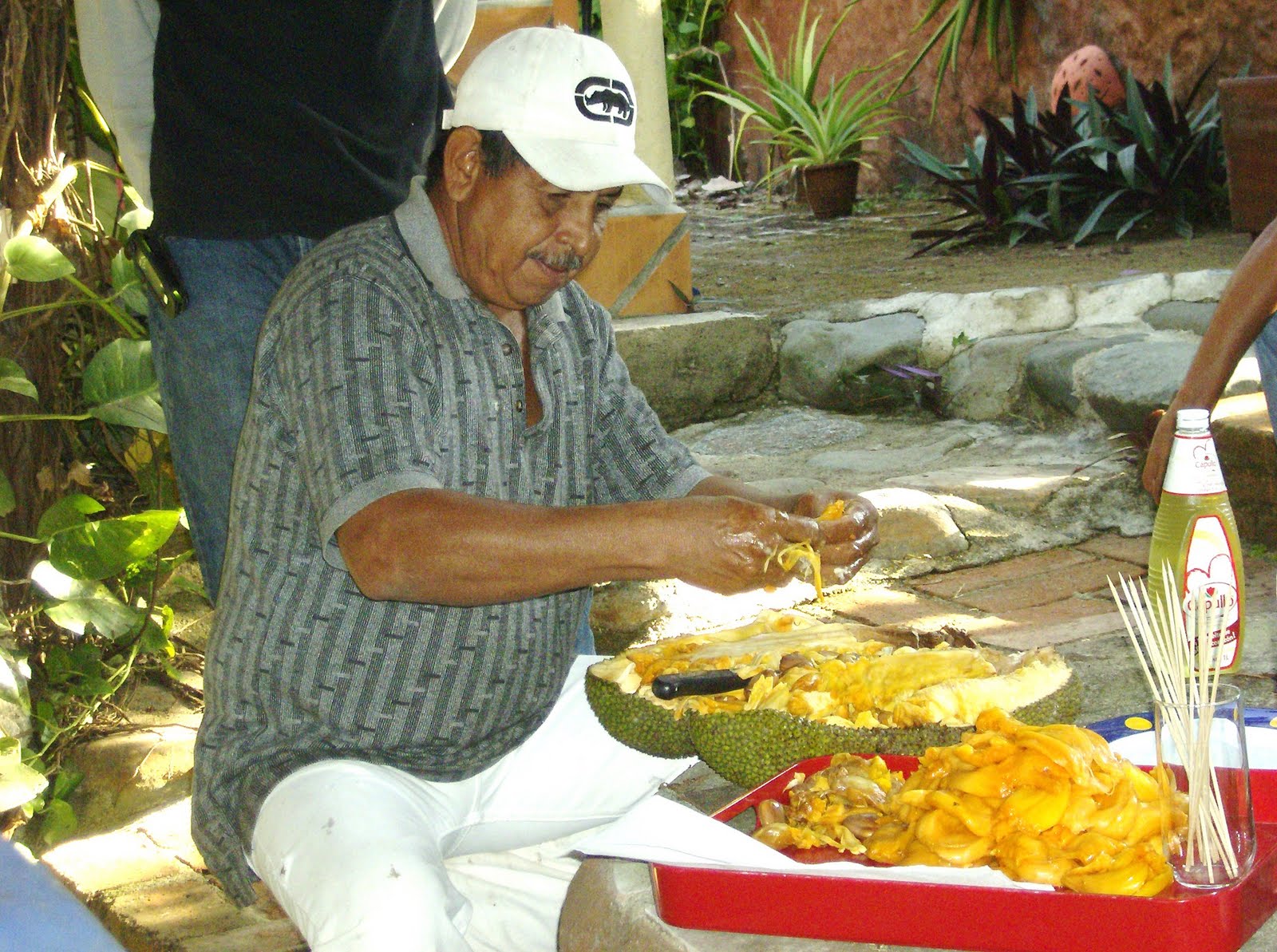
Today Manuel brings us a gift. Unannounced, he lumbers down the steps that lead from the street to our garden retreat lugging a bulbous object with both hands. His knees are splayed wide to better support the weight of what he carries. Teenage sons Harry and Edgar bring up the rear.
"Yaka," says Manuel. He looks around for an appropriate perch in which to set it down. The wide edge of the pool will do. "Deliciosa, y para la salud, excelente."
"He says it tastes good. And it’s good for you." Harry translates although we easily get the drift of where the scenario is going. Edgar wrinkles his nose. We soon learn why.
My husband and I had seen the gigantic globes of yaka, or jackfruit, hanging from hooks at fruit stands alongside the highway between Las Varas and San Pancho. We had never given close inspection. I scrutinize this specimen with suspicion as to edibility. The greenish pimply rind looks like a porcupine with snubbed-off quills. Harry tells us he doesn’t particularly like the taste of the fruit, but it’s okay when blended with milk and banana for breakfast. "Good for virility," he adds.
Okay. I’m game.
Manuel requests a knife, cooking oil, a bowl, another bowl with water, discarded newspaper. The ceremony begins. Like a surgeon he makes a clean cut, severing the beastie in two. He douses both hands in vegetable oil and plunges inside the folds of the fruit. Up to his wrists he curls his fingers around two-inch-long brown pods nestled beneath slippery squares of pale orange flesh. Pods tossed on the newspaper, pulpy flesh plopped in the bowl of water. A strong scent, like cheap perfume from the five and dime.
About 30 minutes later Manuel’s midwifery yields dozens of pods and a bowl heaped with slimy-looking foodstuff. He dunks the fruit a bit, swirls it around the bowl, offers me first bite.
Tastes like over-ripe cantaloupe this side of floozy: a little too much scent and slick for my taste, but, hey, it is interesting. Samples all around. My husband, Win, looks askance. Harry passes. So does Edgar. Manuel takes a sizeable chomp, grins.
Tastes like over-ripe cantaloupe this side of floozy: a little too much scent and slick for my taste, but, hey, it is interesting. Samples all around. My husband, Win, looks askance. Harry passes. So does Edgar. Manuel takes a sizeable chomp, grins.
I thank Manuel for expanding my culinary experience. He thanks me for the work we provide his family, and for the referrals we are happy to give our friends.
"Le gusta armadillo?" he asks, as he prepares to leave. I look at Harry. I look at Edgar. I look at Win. "Did Manuel say armadillo?" I ask."
"Afraid so," says Win.
Sunday, October 31, 2010
Julio, My Poetic Spanish Teacher

I’ve had a lot of Spanish teachers, and Julio Delgadillo was one of the best. Julio is a Mexican architect who lives in San Pancho, and he and I first met in 2003. The architecture business was slow, and Julio was playing guitar and singing in a local café. Between songs he often recited a poem that drew the crowd’s rapt attention. His delivery was perfect: a deep baritone, flawless diction, just the right amount of dramatic emphasis. I asked him about the poem, which he said was La Casada Infiel (The Faithless Wife) by the Spanish poet Federico Garcia Lorca.
I strained to understand the words Julio recited, but my Spanish wasn’t up to it, so I bought a dual-language anthology of Spanish poetry and read the poem in English. Sensual and mysterious, it was the story of a gypsy’s romantic encounter with a woman he had believed was unmarried.
Knowing I was a fan, Julio stopped to say hello when we saw each other around San Pancho. We chatted as best we could, given that neither of us knew much of the other’s language. Soon Julio was stopping for morning coffee on my porch, toting his English books. Eager to practice Spanish with a native speaker, I was ready with my Spanish dictionary and "501 Spanish Verbs".
Julio and I talked for hours about social customs in the U.S. and Mexico, music, politics, the best places to shop, Mexican art, Julio’s architecture projects, and his love life. We checked with each other regularly for new chisme (gossip) from the village. But our most interesting topic was poetry. Julio’s favorite poet was the Chilean Pablo Neruda. In the ‘90s I had seen the Italian film Il Postino, a story based on Neruda’s year in Capri, but I hadn’t read his poems. Now Neruda became a favorite of mine, too.
Though Julio came from humble circumstances, he is a person whom Mexicans might describe as educado. More than “educated,” the word connotes “well-mannered, polite.” He was born in 1959 to a poor family in a tiny village near Tepic, Nayarit. Julio’s parents had split up, and he was cared for by a grandmother and an aunt. As a young boy he tended the family’s cows and goats, and, although his father was a teacher, Julio’s schooling was not a priority. In 1973 he and his father moved to San Pancho, where his father found work.
By the time Julio was in secondary school, he showed talent for drawing and reciting poetry. His teachers picked him to do the customary poetry recitation at end-of-the-year ceremonies. At first he did it simply because he had to, but then he realized his recitations distinguished him from the other kids, and he began to enjoy them. Julio demonstrated for me how he had perfected his diction: He placed a pencil crosswise between his teeth, and then practiced the words to the poem. A teacher gave him a poetry book -- “Five Hundred Famous Poems” -- and the first poem he memorized was “The Faithless Wife.”
Friday, September 3, 2010
Danger
This is my new response to the question, “Are you safe in Mexico?”
“As safe as I am in Evanston, Illinois” I say. Here’s why.
It is 5:00 pm on a hot and sunny Fourth of July. We are ready for a cook-out, a good old fashioned fourth; hamburgers and hotdogs, fresh corn on the cob and potato salad. Comfortably encamped on our deck with friends, we have iced drinks in hand.
Police cars, sirens screaming, screech to a halt outside. They block our street. If the sheer number of squad cars is any indication of a threat to our safety, we are in serious danger. We watch as police claim access to the back yards and alleys on foot, rifles at the ready. What is going on?
Murder, just blocks away. A twenty year old male was shot and killed while driving his car; a gang retaliation. Bloodied, dying, his car crossed two lanes of traffic and crashed onto the opposite sidewalk. On this bright sunlit day, miraculously no one was in his path. He died alone. Now, the search is on for his attacker.
A familiar tale told and retold in the media, both in Mexico and the U.S. Murders, the mayhem of drugs and violence, bodies strewn across the country. Mexico produces the drugs; the U.S. consumes them. Drug lords and gang members, locked in the world of suppliers and users kill each other on both sides of the border. There is no escaping the war that is being waged, not in Mexico or in our quiet suburb of Chicago. It’s the cost of doing business and we are all paying the price.
News reports the next day describe the victim alternately as a hoodlum with a long arrest record and as a misguided young man, mixed up with the wrong crowd. Outrage is expressed that the revelation of his crime-ridden past somehow dimishes the loss of his young life. Perhaps there was promise ahead, if only he had resisted the pull of gangs and drugs.
“If only…” we say, thinking of choices and risks. I know we won’t walk away from our rich full life in Mexico nor will we abandon Evanston, where we have spent half of our lives. We have made our choices; as for the risks, we’ll take them too.
“As safe as I am in Evanston, Illinois” I say. Here’s why.
It is 5:00 pm on a hot and sunny Fourth of July. We are ready for a cook-out, a good old fashioned fourth; hamburgers and hotdogs, fresh corn on the cob and potato salad. Comfortably encamped on our deck with friends, we have iced drinks in hand.
Police cars, sirens screaming, screech to a halt outside. They block our street. If the sheer number of squad cars is any indication of a threat to our safety, we are in serious danger. We watch as police claim access to the back yards and alleys on foot, rifles at the ready. What is going on?
Murder, just blocks away. A twenty year old male was shot and killed while driving his car; a gang retaliation. Bloodied, dying, his car crossed two lanes of traffic and crashed onto the opposite sidewalk. On this bright sunlit day, miraculously no one was in his path. He died alone. Now, the search is on for his attacker.
A familiar tale told and retold in the media, both in Mexico and the U.S. Murders, the mayhem of drugs and violence, bodies strewn across the country. Mexico produces the drugs; the U.S. consumes them. Drug lords and gang members, locked in the world of suppliers and users kill each other on both sides of the border. There is no escaping the war that is being waged, not in Mexico or in our quiet suburb of Chicago. It’s the cost of doing business and we are all paying the price.
News reports the next day describe the victim alternately as a hoodlum with a long arrest record and as a misguided young man, mixed up with the wrong crowd. Outrage is expressed that the revelation of his crime-ridden past somehow dimishes the loss of his young life. Perhaps there was promise ahead, if only he had resisted the pull of gangs and drugs.
“If only…” we say, thinking of choices and risks. I know we won’t walk away from our rich full life in Mexico nor will we abandon Evanston, where we have spent half of our lives. We have made our choices; as for the risks, we’ll take them too.
Friday, August 13, 2010
What I Did On My Summer Vacation

My husband and I recently attended one of the Hay Festivals. In 2010-2011 they are being held in Wales, Cartagena, Beiruit, Kerala, Nairobi, the Maldives, Belfast, Segovia and Zacatecas—conveniently located about nine hours away from our summer home in San Sebastian. Writers, musicians, film makers, scientists, and social entrepreneurs talk, play, screen and inspire; Bill Clinton called it “the Woodstock of the mind.”
The festival was a brilliant experience and the romance of the city couldn’t be missed. A lecture might be held in the Antiguo Templo de San Augustin or in the partially ruined nave of the ex-convento which now houses the Museo Rafael Coronel with it’s collection of 1600 Mexican masks. The open-air concerts, and what perfect high altitude summer air it was, were held in a plaza created by a cluster of colonial jewels. Our hotel, formerly a bishop’s palace, had displayed Morelos’ severed head for two weeks on its tour of Mexico during the Revolution. Other historical sites, templos, museos and ex-conventos crowd the small Centro; we tried to see them all.
At the of the other Coronel brother, Pedro, one of Mexico’s most noted twentieth century artists, the visitor enters through a library. Once belonging to the ex-convento that houses the museum, the library is a grand room, perhaps seventy feet long with sixteen- or eighteen-foot ceilings and high windows set in the thick walls. The upper reaches of the shelves are lost in the dim light and are packed with leather-bound and gold-tooled volumes. We immediately began to see treasures—first editions of Bernal Diaz’s history of the conquest of Mexico and of Prescott’s conquest history in Spanish translation. As other museum goers passed through the library and on to the rest of the collection, we were riveted, exclaiming over and examining every shelf until the distinguished old librarian offered to let us see whatever book we wanted. He extracted whatever we asked for, bringing it to the lectern on the little desk beneath the window and turning the pages for us with his gloved hands.
Then he offered to show us the rest of the library. We passed through a black-curtained arch into another room, even larger, at a right angle to the first, taking up the entire side of the former convent. This room, the librarian explained, contained books from the fifteenth and sixteenth centuries. Every one was bound in parchment, discolored and crinkled, with hand-scribed titles on the spines in red and black ink. Then a third room along the back of the convent. Here were books with balsa wood covers and brilliantly marbled end papers, dictionaries, atlases, a facsimile of the Mendocino Codex, one of the few Aztec codices to survive the Spanish bonfires.
All that was a dream experience, but then this: Write out a solicitud, a request, go to the pharmacy and buy a left-over swine flu mask and latex gloves and all this was mine for the examining. I did it. Just another couple of hours, I assured Jonathan, but it took an extra day in Zacatecas before I tore myself away. Ask me what items and how much of them Montezuma received in tribute each year and what a parchment-bound Vulgate Bible feels like, book worm trails and all. I saw a collection of photos (not prints of photos) of Mexican churches taken by Frida Khalo’s father, an engraved map of Mexico City and surrounds when it was in the middle of the lake and reached by causeways and fifteenth century stories of the missionaries who brought Christianity to Ethiopia. I could go on.
One isn’t trusted around rare books in the US. I once (barely) got into the stacks of the Yale University Library even though supervised by my daughter who had access as a student. And the really old and valuable stuff isn’t there anyway, it’s over in the Rare Book and Manuscript Library and you aren’t getting in there without a letter of introduction from your academic advisor. Zacatecas is a good place to be reminded of how pleasant a society Mexico can be.
Tuesday, June 8, 2010
A San Pancho Grande Dame


In 1986, Gloria and Ken Hanson built the first home in the San Pancho jungle area called Costa Azul. After searches in Guatemala and the West Indies plus advice from friends in La Peñita, they visited Costa Azul.
1 c. bread crumbs
1 small onion, diced
2 eggs, beaten
¼ c. catsup
¼ c. milk
2 T. salsa verde
1 T. Worcestershire sauce
2 t. salt
1 t. black pepper
Wednesday, June 2, 2010
Corazón de Agave
The Pinot Noir my husband is making in San Sebastian needed time in an oak barrel for its finish. He ordered one from a cooper in Tequila and we combined the pick up with touring visitors around the sights. It is a beauty, the barrel, 200 liters, 50 gallons or so, bearing the name of our winery, Las Fincas. The oak comes from Kentucky. If it’s good enough for Mexican tequila it’s good enough for Mexican wine, we say. Besides, I heard they’re cutting down the forest of Fontainebleau outside of Paris for that precious French oak.
Visitors in tow, we toured the Herradura tequila factory. The cores of agave azul, called piñas for their resemblance to a pineapple, are roasted and pressed, the juice fermented and distilled. One always is treated to a taste of the roasted piña on such tours—delicious, smoky-sweet and very fibrous. You are reminded that alcohol comes from sugar. The agave has plenty.
Down the road we stopped by a little table where half a roasted piña was laid out for sale. We were offered the ends of the cut-off spears which were mahogany dark and roasted to caramel perfection. We separated the sweet stuff from the fibers with our teeth just as you’d get the meat off an artichoke leaf. We had already made out purchase when, seemingly as an after-thought, the seller offered us a sample from the piña’s center, its heart, its corazón. It was firmer than the heart of an artichoke but similarly smooth, no fibers. It was even more delicious than the spear ends. We were ravished. I bought a large wedge and began to brain-storm recipes.
First came pork loin cooked and sauced in corazón de agave. In my test kitchen, also known as my kitchen, I wrapped the pork in the fibrous spear-ends, encased it in foil and roasted it slowly. Fibers were strained out, sweetened juices reduced and mellowed with cream, cubes of corazón heated and served beside the meat. Oh, boy.
Then there was corazón de agave pecan pie. I heated two cups of corazón bits with a cup of orange juice and thickened it with flour. Some orange zest for that little edge. After the mixture cooled, I blended it with three beaten eggs and lightly-roasted pecans, poured it into a pie shell and baked it for an hour. Served with cream, it was better than mincemeat.
Now friends are in the act. Lorena made corazón de agave ice cream. Canela proposed mashing it and serving it instead of yams beside the Thanksgiving turkey. Imagine chunks in capirotada, Mexican bread pudding. Feel free.
Subscribe to:
Posts (Atom)

