Monday, February 18, 2013
Please visit our new website and blog
Saturday, February 11, 2012
Attachments
Naïve, brash, we fused into community, strangers who quickly grew familiar. We shared the travails of living in a country foreign to us, the richness of another culture, the hilarity of misunderstanding. We gossiped about the locals, traded shopping tips, and directed each other to great dining on a soldier’s salary.
With youthful exuberance we gathered together for traditional holidays and to celebrate birthdays, anniversaries and promotions. We formed attachments.
Fast friendships held for two, three, sometimes four years. Reassignment meant bittersweet goodbye with promise to write, call, and of course visit whenever paths might cross again. But the annual holiday greeting cards, the occasional birthday phone calls dwindled through the decades. We moved on.
Lately I have begun to reflect on that tight-knit community in which we lived forty-odd years ago.
In March 2005 my husband and I discovered San Pancho and within days purchased a winter home. We decided to live outside North America part of the year because we wanted sunshine, adventure, challenge, a touch of adversity to prove a bit of mettle still remains.
During the years we have met like-minded souls with whom we share the fun and trouble of living in a foreign place. We gossip about the locals, trade bargaining tips, and direct each other to great dining on social security salary. Attachments are cemented through weekly card games on the beach, shared dinners in the pueblo, organized hikes, and a myriad of volunteer opportunities.
But those attachments are not as furious as the ones formed 40-odd years ago. A sigh beyond the middle years, many of us have begun to assess stamina, security, and stability for the years ahead; some of us have begun to contemplate life more comfortable than life carved here.
Some of us are selling our homes in San Pancho, ready to move on. As before, there are promises to keep in touch, crisscross the country every couple of years to visit, call to commiserate the state of the States, comfort one another in time of need. But the attachments we have formed seem substantive this time around. Perhaps because there is less time to subjugate the priority of friendship. With age comes simplicity.
Attachments frayed with age, perhaps, but not with time.
Friday, October 28, 2011
El Arco Norte
Rejoice! There is now a Mexico City bypass. Until five months ago, we on the Pacific side of Mexico had to drive through the western hemisphere’s largest metropolitan area to get pretty much anywhere east or south of it. And it wasn’t easy.
We recently headed for Xalapa in the state of Veracruz. We checked online for the day the last digit of our license plate would forbid us to pass through Mexico City, slept in Toluca and mounted the assault the next morning. It was a good passage with only one stop to ask directions and was accomplished in about an hour. In fact, it was spectacularly good because, when we got gas on the far side at about 10:30, we learned about an additional rule: No out-of-state cars on the road until 11. The last time we made a mistake, it took 2000 pesos to get out of it.
While in Xalapa word came to us of the bypass, El Arco Norte, and we took it going home. Here’s how:
East-West. Past Puebla you exit the main highway at Texmelucan where it’s almost well marked. A warning sign says El Arco Norte; the actual turnoff says Hwy 57 to Querétaro. At an un-manned toll plaza you eventually figure out to push a button and take a plastic card. The route, through beautiful, sparsely populated countryside north of Mexico City, proceeds past a turnoff to Pachuca, past a turnoff to Querétaro, and on to the exit at Atlacomulco where you pay 340 pesos. Atlacomulco is located at the point where the highway from Guadalajara turns south toward Toluca.
West-East. The exit is not marked “El Arco Norte” but there’s an Atlacomulco exit sign and another that indicates it’s the road to Querétaro.
The route takes about an hour more than going through Toluca and Mexico City but I estimate that the relaxation will add about four days to your life expectancy.
Sunday, September 11, 2011
Another San Pancho Writer Breaks Out

One of our number, Ellen Greene, published a wonderful book called Remember the Sweet Things (William Morrow/HarperCollins) in 2009, and now I’ve followed her with The Lives of La Escondida (Lirio, 2011.) When we started our writers’ group several years ago, publishing was only a gleam in our eyes, though we were all serious about our “craft” and a couple of us had books in the works. I think both Ellen and I would say that our writing group was catalytic in our writing process.
Things are strange in the book world these days. Barry Eisler (writer of bestseller thrillers) turned down a $500,000 advance in favor of self-publishing on Amazon’s CreateSpace after a hard look at the bottom line. Considering that an advance is, by definition, to be paid back from royalties; that book royalties from publishing houses run in the 10-15% range, while you’ll get more like 40% if you self-publish—with the disparity even greater for the e-version—the math was clearly in favor of the Indie approach.
Of course, Eisler was already well known and has no need for the book tours and all the other publicity efforts of the established publishing houses. Oops, make that the book tours, etc. that used to be part of the package at the established houses. Now, times are tough, and HarperCollins belongs to Rupert Murdoch.
And those traditional houses accept manuscripts only through literary agents, and agents take a hefty percentage, too, if you can land one, which I hadn’t when I stopped trying. I stumbled upon a publisher that would accept author submissions. I submitted; I was accepted! But if something seems too good to be true… After nearly two years of dealing with rank amateurs—extending to their knowledge, or lack thereof, of grammar and punctuation, and a refusal to allow the book to appear in e-form—I extricated myself from my contract.
What’s more, the publisher was going to print my book using CreateSpace, and then give me 10%. Sure, he provided me an editor—whose work I couldn’t use—and a proof-reader—who wouldn’t consider even the Chicago Manual of Style (“We aren’t in Chicago.”) Those, if competent, are worth a lot. However, the publisher wasn’t paying these people—thus justifying his percentage. They were working for royalties, too, and their work was slow since these weren’t their day jobs, which they should never consider quitting.
So, like Barry Eisler, I published on CreateSpace, and I make about two dollars more per book than Kathryn Stockett gets for The Help. (It won’t be necessary for you to point out who is likely making more money.) For fees, CreateSpace will edit, proof, or design, but you may do it all yourself virtually free of charge. And, if there are tricky bits, there is also prompt and competent tech support. For ten dollars, one can have an ISBN attached to a publishing house of one’s own—mine is named Lirio, from Casa de los Lirios, my San Pancho home.
My book is a romance that violates some of the conventions, hopefully making my characters more lifelike, while still devastatingly appealing. I based it in New Mexico where I lived for thirty-seven years, and in Mexico, too. There, in the 1590s, the Inquisition drove suspected Jews north to New Mexico where they went underground and hang on until this day. The book is available on Amazon and in all e-reader forms, as described on my webpage: www.carolynkingson.com.
Thursday, September 1, 2011
Tlacuaches Trumped
Opossoms, (tlacuaches, in Spanish), find my San Pancho home agreeable, as I’ve complained in several posts. Yes, they can have some bad habits, such as chewing through the gas line to my stove and causing an explosion, but I’ve now achieved perspective. My daughter found baby-blues to be too much, my grandbaby beckoned, and I’ve moved to London for a time to be what help I can. And it is London that has opened my eyes.
And how has London, more precisely, Chiswick, done this? Chiswick with its meandering streets, some of which probably follow old cow paths; where dropped items hang on fences until reclaimed; dense with prams and nannies and lovingly tended gardens; home of Colin Firth, for crissakes—is infested with foxes. Walk home after dark, gaze out into the garden early in the morning, and you’re sure to see them starting out on the night’s business or heading back to the den, which is probably hidden under a garden buddleia, maybe yours. But don’t think they aren’t out in the day, too. These foxes look as though they have no need of “sly” or “wily;” those traits were apparently given up as unnecessary long ago. A better epithet would be “arrogant as a fox.” They don’t slink or skulk home in the grey-green morning light. These animals are alpha, top, apex predators. And I’m not overlooking humans.
I say without fear of contradiction that everyone in the UK knows that a fox entered an east London house, went upstairs, and mauled twin baby girls in their crib—one on the face. When the screams brought the parents running, they found the fox sitting as calmly as if it were the family dog. It was headline line news when the babies finally got out of the hospital. Tlacuaches would never do anything like that.
Another baby was attacked while sleeping beside its mother on the sofa. The woman whose house I’m staying in found one in her living room with her three-year-old. They regularly tear up my daughter’s garden. Everybody has a story. It’s been hot, but do you think you dare leave open a ground-floor window?
Foxes have a devoted following in England. Fox hunts—“…the unspeakable in full pursuit of the uneatable.” (Oscar Wilde)—were a target for animal rights advocates for decades and are now banned. One may be arrested for killing or trapping a fox—though, I presume you’d get off lightly if it could, definitively, be shown to have injured your baby. It’s hard to understand why some humane fox removal is not being attempted until you realize that there’s no place in England that isn’t already full of foxes. Given that, one wonders why the men aren’t out with torches and pitchforks at night.
And if it’s not enough that foxes threaten babies, they kill house cats. (In fairness, I note that The National Fox Welfare Society disputes this and says they only chase them away from their kits, or tease them. Italics, and scepticism, mine.) You’d think even a rumour of cat-killing would put the nail in the fox coffin, cats being nearly as essential to human happiness as babies. And while London wrestles with its dilemma, we hold our grandchildren close and think of the mild-mannered tlacuaches of San Pancho.
Monday, April 4, 2011
On the Road Again
ruins recently excavated near San Miguel de AllendeI often lament to friends and family my not traveling as much as I say I would like. Well, I haven’t booked a flight to Buenos Aires yet, but I did take some baby steps in the past few weeks by driving around Central and Western Mexico with a friend. We stopped in Lagos de Moreno, Guanajuato, San Miguel de Allende, Patzcuaro, and Morelia on the first leg, then Mascota, Talpa, and Tapalpa on the second.
“Isn’t that dangerous?” more than one person asked when they heard of my plan. Holdups and random acts of violence permeate the news from Mexico.
Capula, the pueblo I was looking for, remains one of my favorites. Famous for its “brownware,” i.e. brown clay tableware, hand painted and glazed, Capula’s finest artisans are pointillists whose intricate fish and birds vibrate with color. Fabulous prices (around $20 USD for a plate beautiful enough to hang on a wall + matching salsa bowl) meant I could load up on gifts for friends as well as refresh my own stock at home in San Pancho.
Thursday, February 24, 2011
Valentine's Day in El Tuito
A large fellow wearing a black plastic apron hopped out of the truck, pulled up the metal door of the butcher shop next to our restaurant and backed up the truck smack against our table. I know what’s going to happen next, I thought, and I’m not going to let it bother me. Our coconut shrimp arrived.
The burly butcher slung a side of beef over his shoulder and carried it into his shop. He looked like a strong guy, but it wasn’t easy. Not going to bother me, not going to bother me, I repeated to myself. I thought of my vegetarian daughter, and though I miss her, I was glad she was not there at that moment. The butcher finished unloading the carcass just as we polished off the coconut shrimp.
We settled up with Valle Azul and I asked the butcher what he did with the horns. Unless they are especially big ones, he said, he throws them out. Seems a shame, I thought, but if there is something useful you could do with cow horns, a butcher would have thought of it by now.
In hopes of getting a photo memento of our special Valentine’s Day dinner, we stopped the next morning at the butcher shop. The sides of beef hung from hooks behind the counter, where the butcher stood, slicing fat from chunks of steak. “That was one big cow,” I observed as a conversation starter. “Very heavy, about 500 kilos--more than a thousand pounds,” he said. The butcher, whose name is Joaquin Gómez, seemed pleased when I asked if I could take a photo, and he wondered if it would be on the Internet. “I don’t have email myself,” he said, “but my sister in California does, and she can send me a copy.”
So here’s to you, El Jardin del Tuito and Joaquin Gómez. And thank you for making Valentine’s Day 2011 a memorable one.
Tuesday, February 8, 2011
The Big Chill
There is some comfort in knowing that I am not the only person piling on the layers. Hooded sweatshirts have appeared in the pueblo. Workers huddle in the rear of pickups wearing jackets that look alarmingly like parkas. Bundled against the cold, the children are hurried along, their small feet scuffling in oversized boots. Boots?
Still, I am reluctant to mention the weather to friends and family back in the States. I am not likely to get much sympathy when they haven’t had a ray of sunshine in six weeks and the high temperature for the day is 10 degrees. And it’s true, despite the record chill, afternoons here are in the 70s and balmy; we can go to the beach.
When friends were planning a visit recently I pondered how to suggest they bring one or two warmer items to wear.
“It is a little cool in the morning,” I wrote, “and again in the evening.”
Just as I expected they reminded me of their winter endurance skills. Fine I thought, we’ll see, and put the small electric heater in their room, just in case.
It wasn’t until they had been here a few days that they conceded it was a little “cooler” than they had remembered from last year.
“Dinner on the patio?” I asked, as I carried our plates toward the door.
“Maybe eating inside would be cozier,” our guests said.
In front of the oven?
Monday, January 17, 2011
Back in Business
As I walked down San Pancho’s main street in mid-October, a sign in a shop window caught my eye: “20% OFF ON EVERYTHING UNTIL THE BRIDGE IS FIXED.” Now that sign is gone. People and vehicles can cross the river into San Pancho again, and the Avenida is bustling with commerce.
Torrential rains in early September caused flooding, mudslides and bridge collapses throughout the Bahia de Banderas area. “The most rain I can remember in 50 years,” one San Pancho old-timer said. On September 6 rushing water and fallen trees slammed into the San Pancho bridge. It collapsed, creating a crisis in both economic and human terms: The village was cut off from Highway 200 and the rest of the world; families who lived near the river banks became homeless overnight; houses were inundated with up to four feet of water.
The people of San Pancho rallied. They improvised a zipline across the river and then threw together a rickety wooden footbridge. Seventy people whose homes had been washed away lived and ate for two weeks in EntreAmigos, the town’s community center. The owners of La Patrona Polo Club donated things like baby diapers and food and sent a boatload of supplies to the San Pancho beach.
High-riding SUVs could ford the river not long after the washout, but regular cars couldn’t make it across. The water was just too high. To solve this problem a raised dirt embankment was built in late October. It is only one lane, and if you don’t have your wits about you, your car could slide into the water, but the embankment serves its purpose. Regular vehicle traffic in and out of San Pancho resumed.
Local people saw a business opportunity: all those hungry bridge workers; heavy traffic all day on the embankment. New taco stands sprang up, one of which also advertises low-cost haircuts and manicures. A portable hot dog stand parks at the site. An enterprising woman sells clothing, displayed on a clothesline like clean wash. Victoriano Mendez, the artist who used to set up his easels near the bridge, has returned, painting and selling his landscapes.
Construction is almost complete on the new bridge. San Pancho is back in business.
Wednesday, January 12, 2011
The Night Visitor
No way, now I am awake. I strain to hear the noise again; did we lock the bedroom door I wonder? But now there is only the usual cacophony of our neighborhood: dogs, roosters, faint strains of music. I drift into an uneasy sleep.
Monday, January 3, 2011
Tlaquache Terrorism
The other night I was minding my own business, heating up some leftovers for dinner on top of the stove. I had just stirred the pot and returned to the living room when the stove exploded. The Le Creuset pot flew up and over the island and landed upside down; the burner apparatus and grills likewise, the oven door blew open and wisps of insulation streamed from the joints. The neighbors came running to see if we were still alive.
Alive, yes, but considerably shaken and also dumbfounded. The oven hadn't been on; I had been cooking daily—now I vowed never to go near the stove again. It wouldn't have been pretty if I had stirred that pot a few moments later than I did. We shut off the gas, cleaned up the mess and went out to dinner. We planned to check out the stoves in the shop on the corner in the morning and when we did, we found a nice one that went better with my dishwasher anyway.
But first we really had to make an inspection. Jonathan pulled the stove out of its slot in the counter. There sat a slightly singed tlaquache in a nest of leaves showing its vicious little teeth—teeth which it had used, in its spare time, to chew through the metal mesh-clad gas line. As a parting insult, when Jonathan drove it out from under the stove, it ran and hid under the dishwasher and he had to disconnect and pull that out, too. The possum finally scurried off into the garden, where, animal lovers, it plots with impunity—for the time being.
Saturday, December 18, 2010
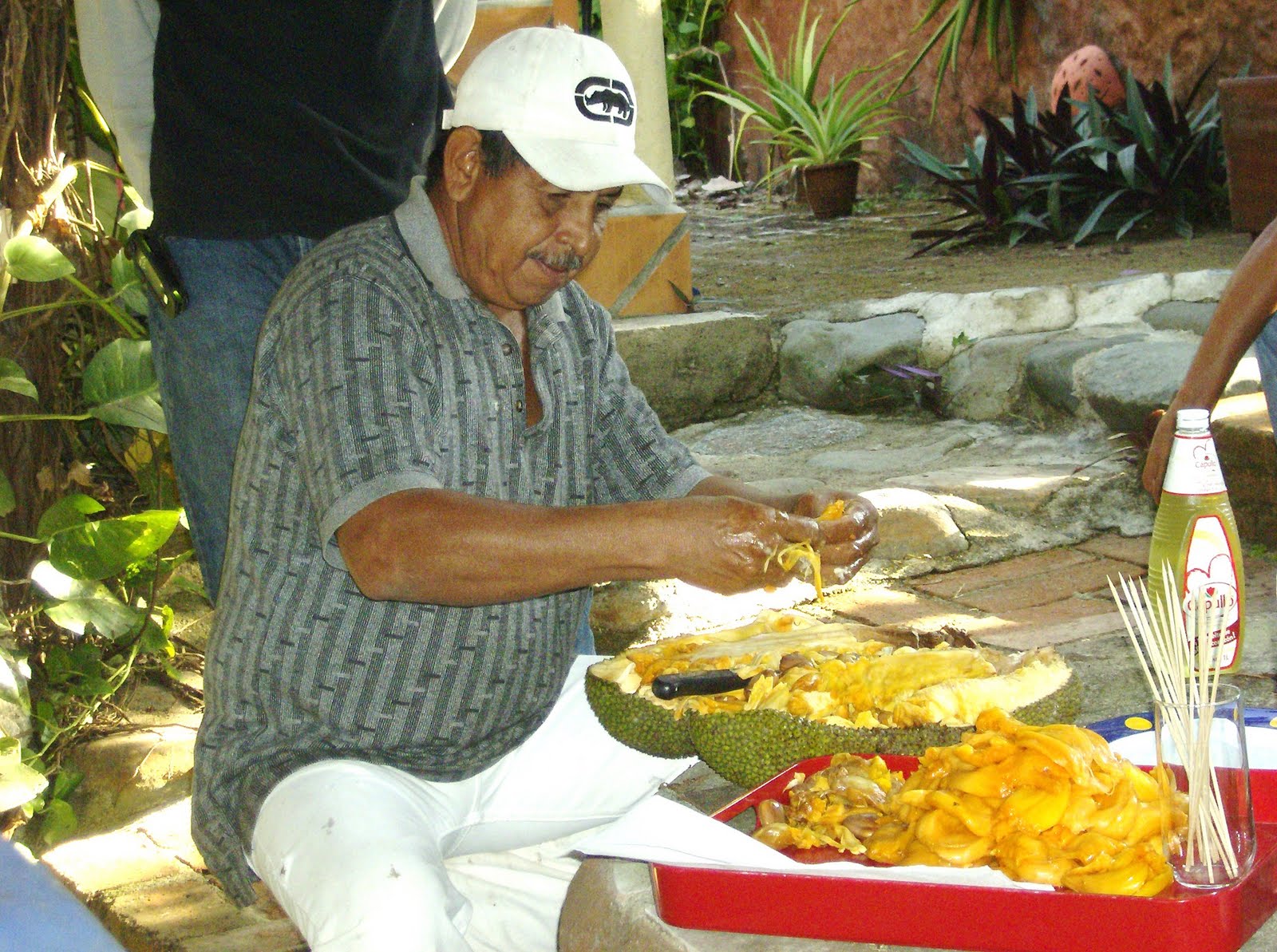
Yakati Yak Jack
Tastes like over-ripe cantaloupe this side of floozy: a little too much scent and slick for my taste, but, hey, it is interesting. Samples all around. My husband, Win, looks askance. Harry passes. So does Edgar. Manuel takes a sizeable chomp, grins.
Sunday, October 31, 2010
Julio, My Poetic Spanish Teacher
I’ve had a lot of Spanish teachers, and Julio Delgadillo was one of the best. Julio is a Mexican architect who lives in San Pancho, and he and I first met in 2003. The architecture business was slow, and Julio was playing guitar and singing in a local café. Between songs he often recited a poem that drew the crowd’s rapt attention. His delivery was perfect: a deep baritone, flawless diction, just the right amount of dramatic emphasis. I asked him about the poem, which he said was La Casada Infiel (The Faithless Wife) by the Spanish poet Federico Garcia Lorca.
I strained to understand the words Julio recited, but my Spanish wasn’t up to it, so I bought a dual-language anthology of Spanish poetry and read the poem in English. Sensual and mysterious, it was the story of a gypsy’s romantic encounter with a woman he had believed was unmarried.
Knowing I was a fan, Julio stopped to say hello when we saw each other around San Pancho. We chatted as best we could, given that neither of us knew much of the other’s language. Soon Julio was stopping for morning coffee on my porch, toting his English books. Eager to practice Spanish with a native speaker, I was ready with my Spanish dictionary and "501 Spanish Verbs".
Julio and I talked for hours about social customs in the U.S. and Mexico, music, politics, the best places to shop, Mexican art, Julio’s architecture projects, and his love life. We checked with each other regularly for new chisme (gossip) from the village. But our most interesting topic was poetry. Julio’s favorite poet was the Chilean Pablo Neruda. In the ‘90s I had seen the Italian film Il Postino, a story based on Neruda’s year in Capri, but I hadn’t read his poems. Now Neruda became a favorite of mine, too.
Though Julio came from humble circumstances, he is a person whom Mexicans might describe as educado. More than “educated,” the word connotes “well-mannered, polite.” He was born in 1959 to a poor family in a tiny village near Tepic, Nayarit. Julio’s parents had split up, and he was cared for by a grandmother and an aunt. As a young boy he tended the family’s cows and goats, and, although his father was a teacher, Julio’s schooling was not a priority. In 1973 he and his father moved to San Pancho, where his father found work.
By the time Julio was in secondary school, he showed talent for drawing and reciting poetry. His teachers picked him to do the customary poetry recitation at end-of-the-year ceremonies. At first he did it simply because he had to, but then he realized his recitations distinguished him from the other kids, and he began to enjoy them. Julio demonstrated for me how he had perfected his diction: He placed a pencil crosswise between his teeth, and then practiced the words to the poem. A teacher gave him a poetry book -- “Five Hundred Famous Poems” -- and the first poem he memorized was “The Faithless Wife.”
Friday, September 3, 2010
Danger
“As safe as I am in Evanston, Illinois” I say. Here’s why.
It is 5:00 pm on a hot and sunny Fourth of July. We are ready for a cook-out, a good old fashioned fourth; hamburgers and hotdogs, fresh corn on the cob and potato salad. Comfortably encamped on our deck with friends, we have iced drinks in hand.
Police cars, sirens screaming, screech to a halt outside. They block our street. If the sheer number of squad cars is any indication of a threat to our safety, we are in serious danger. We watch as police claim access to the back yards and alleys on foot, rifles at the ready. What is going on?
Murder, just blocks away. A twenty year old male was shot and killed while driving his car; a gang retaliation. Bloodied, dying, his car crossed two lanes of traffic and crashed onto the opposite sidewalk. On this bright sunlit day, miraculously no one was in his path. He died alone. Now, the search is on for his attacker.
A familiar tale told and retold in the media, both in Mexico and the U.S. Murders, the mayhem of drugs and violence, bodies strewn across the country. Mexico produces the drugs; the U.S. consumes them. Drug lords and gang members, locked in the world of suppliers and users kill each other on both sides of the border. There is no escaping the war that is being waged, not in Mexico or in our quiet suburb of Chicago. It’s the cost of doing business and we are all paying the price.
News reports the next day describe the victim alternately as a hoodlum with a long arrest record and as a misguided young man, mixed up with the wrong crowd. Outrage is expressed that the revelation of his crime-ridden past somehow dimishes the loss of his young life. Perhaps there was promise ahead, if only he had resisted the pull of gangs and drugs.
“If only…” we say, thinking of choices and risks. I know we won’t walk away from our rich full life in Mexico nor will we abandon Evanston, where we have spent half of our lives. We have made our choices; as for the risks, we’ll take them too.
Friday, August 13, 2010
What I Did On My Summer Vacation
My husband and I recently attended one of the Hay Festivals. In 2010-2011 they are being held in Wales, Cartagena, Beiruit, Kerala, Nairobi, the Maldives, Belfast, Segovia and Zacatecas—conveniently located about nine hours away from our summer home in San Sebastian. Writers, musicians, film makers, scientists, and social entrepreneurs talk, play, screen and inspire; Bill Clinton called it “the Woodstock of the mind.”
The festival was a brilliant experience and the romance of the city couldn’t be missed. A lecture might be held in the Antiguo Templo de San Augustin or in the partially ruined nave of the ex-convento which now houses the Museo Rafael Coronel with it’s collection of 1600 Mexican masks. The open-air concerts, and what perfect high altitude summer air it was, were held in a plaza created by a cluster of colonial jewels. Our hotel, formerly a bishop’s palace, had displayed Morelos’ severed head for two weeks on its tour of Mexico during the Revolution. Other historical sites, templos, museos and ex-conventos crowd the small Centro; we tried to see them all.
At the of the other Coronel brother, Pedro, one of Mexico’s most noted twentieth century artists, the visitor enters through a library. Once belonging to the ex-convento that houses the museum, the library is a grand room, perhaps seventy feet long with sixteen- or eighteen-foot ceilings and high windows set in the thick walls. The upper reaches of the shelves are lost in the dim light and are packed with leather-bound and gold-tooled volumes. We immediately began to see treasures—first editions of Bernal Diaz’s history of the conquest of Mexico and of Prescott’s conquest history in Spanish translation. As other museum goers passed through the library and on to the rest of the collection, we were riveted, exclaiming over and examining every shelf until the distinguished old librarian offered to let us see whatever book we wanted. He extracted whatever we asked for, bringing it to the lectern on the little desk beneath the window and turning the pages for us with his gloved hands.
Then he offered to show us the rest of the library. We passed through a black-curtained arch into another room, even larger, at a right angle to the first, taking up the entire side of the former convent. This room, the librarian explained, contained books from the fifteenth and sixteenth centuries. Every one was bound in parchment, discolored and crinkled, with hand-scribed titles on the spines in red and black ink. Then a third room along the back of the convent. Here were books with balsa wood covers and brilliantly marbled end papers, dictionaries, atlases, a facsimile of the Mendocino Codex, one of the few Aztec codices to survive the Spanish bonfires.
All that was a dream experience, but then this: Write out a solicitud, a request, go to the pharmacy and buy a left-over swine flu mask and latex gloves and all this was mine for the examining. I did it. Just another couple of hours, I assured Jonathan, but it took an extra day in Zacatecas before I tore myself away. Ask me what items and how much of them Montezuma received in tribute each year and what a parchment-bound Vulgate Bible feels like, book worm trails and all. I saw a collection of photos (not prints of photos) of Mexican churches taken by Frida Khalo’s father, an engraved map of Mexico City and surrounds when it was in the middle of the lake and reached by causeways and fifteenth century stories of the missionaries who brought Christianity to Ethiopia. I could go on.
One isn’t trusted around rare books in the US. I once (barely) got into the stacks of the Yale University Library even though supervised by my daughter who had access as a student. And the really old and valuable stuff isn’t there anyway, it’s over in the Rare Book and Manuscript Library and you aren’t getting in there without a letter of introduction from your academic advisor. Zacatecas is a good place to be reminded of how pleasant a society Mexico can be.
Tuesday, June 8, 2010
A San Pancho Grande Dame

In 1986, Gloria and Ken Hanson built the first home in the San Pancho jungle area called Costa Azul. After searches in Guatemala and the West Indies plus advice from friends in La Peñita, they visited Costa Azul.
1 c. bread crumbs
1 small onion, diced
2 eggs, beaten
¼ c. catsup
¼ c. milk
2 T. salsa verde
1 T. Worcestershire sauce
2 t. salt
1 t. black pepper
Wednesday, June 2, 2010
Corazón de Agave
The Pinot Noir my husband is making in San Sebastian needed time in an oak barrel for its finish. He ordered one from a cooper in Tequila and we combined the pick up with touring visitors around the sights. It is a beauty, the barrel, 200 liters, 50 gallons or so, bearing the name of our winery, Las Fincas. The oak comes from Kentucky. If it’s good enough for Mexican tequila it’s good enough for Mexican wine, we say. Besides, I heard they’re cutting down the forest of Fontainebleau outside of Paris for that precious French oak.
Visitors in tow, we toured the Herradura tequila factory. The cores of agave azul, called piñas for their resemblance to a pineapple, are roasted and pressed, the juice fermented and distilled. One always is treated to a taste of the roasted piña on such tours—delicious, smoky-sweet and very fibrous. You are reminded that alcohol comes from sugar. The agave has plenty.
Down the road we stopped by a little table where half a roasted piña was laid out for sale. We were offered the ends of the cut-off spears which were mahogany dark and roasted to caramel perfection. We separated the sweet stuff from the fibers with our teeth just as you’d get the meat off an artichoke leaf. We had already made out purchase when, seemingly as an after-thought, the seller offered us a sample from the piña’s center, its heart, its corazón. It was firmer than the heart of an artichoke but similarly smooth, no fibers. It was even more delicious than the spear ends. We were ravished. I bought a large wedge and began to brain-storm recipes.
First came pork loin cooked and sauced in corazón de agave. In my test kitchen, also known as my kitchen, I wrapped the pork in the fibrous spear-ends, encased it in foil and roasted it slowly. Fibers were strained out, sweetened juices reduced and mellowed with cream, cubes of corazón heated and served beside the meat. Oh, boy.
Then there was corazón de agave pecan pie. I heated two cups of corazón bits with a cup of orange juice and thickened it with flour. Some orange zest for that little edge. After the mixture cooled, I blended it with three beaten eggs and lightly-roasted pecans, poured it into a pie shell and baked it for an hour. Served with cream, it was better than mincemeat.
Now friends are in the act. Lorena made corazón de agave ice cream. Canela proposed mashing it and serving it instead of yams beside the Thanksgiving turkey. Imagine chunks in capirotada, Mexican bread pudding. Feel free.
Sunday, May 30, 2010
Miguel and His Murals
At 18 Miguel opened his own taller in Puerto Vallarta . Business was good, and at one point he had three people working for him. They got big commissions—the Sheraton Hotel, the Collage nightclub— for signs, lettering, drawings and murals. During those years Miguel made frequent bus trips back to San Pancho to visit his family, and on one trip he met Julia, a young woman from the village. They became friends, and after three years they married. Miguel and Julia now have three daughters and a baby grandson.
Paint stores may have computerized color matching, but they can’t outdo Miguel’s infallible eye. Choosing paint colors with him is a pleasure. Should the color of a wall be taupe, mushroom, sand or beige? Miguel mixes up a sample on the spot, paints a swath, and we study the result. Not quite right? He mixes another sample, and we try again. With no sign of impatience Miguel spends as long as it takes to get the color right.
Thursday, April 22, 2010
Barefoot in the Kitchen

Tuesday, April 20, 2010
The Librarian: Lonely No More
A large abandoned warehouse at the other end of town had been given to entreamigos but renovating it into useable space was overwhelming. First, it would take a massive effort to clear the building of years of debris and garbage. Then, even with the possibility of a $36,000 grant from The Three Swallows Foundation, the San Pancho community would have to raise twice that amount of money to begin construction.
Did the community care enough to make the effort? When larger cities, including my home town of Evanston, Illinois, are closing their neighborhood libraries, could a project of this size in our small town possibly succeed?
The answer is a resounding “yes.” Having a library and community center did matter. Today entreamigos has a brand-new home; in cash, more than $100,000 was raised. The dilapidated warehouse was restored inch by inch into a completely “green” space through hundreds of hours of volunteer labor and donations of supplies.
A few months ago I sat on the floor in the new library at entreamigos and unpacked all of the old boxes. The newly painted wooden shelves, recycled tires and crates, were ready to be filled. The large, airy space with brightly-painted tables and chairs and comfy pillows beckoned eager readers. It had been a labor of love for all of us, a commitment to libraries and to education that San Pancho was willing to make.
In Evanston, news of a $10 million deficit in the budget sounded the death knell for the neighborhood libraries. Closing the two branch libraries was not a new threat; in fact, it was almost an annual event at budget time. But this year was different, and the end of the neighborhood libraries seemed imminent.There was one possibility. The Branch libraries received a six-month reprieve to raise $200,000. Could the Evanston community raise that amount to keep the Branches open?
To date, 1000 volunteers have raised $65,000 with more commitments of support daily. But a “For Rent” sign in the window of the South Branch library has added to the pressure.
Come on Evanston. If we can do it in San Pancho…